
9 minute read · Zsike Peter
I Want My Own Words Back
Lately, I have noticed myself reaching for “landed”, or “this matters”. I've used “quietly” here and there, too, before catching myself and thinking: this does not belong in this sentence. The problem is, I've encountered it so often in other people's posts, and even in conversation, that it's influencing my own choice of words.
If I wanted to write something like “complex words are quietly disappearing from our language”, what would I mean? Maybe “words might go missing unnoticed until we forget what we're reaching for”. Something along those lines.
Of course there is poetic freedom in how we use a word. But you can overuse it. I might read a sentence and feel that a word doesn't belong there, even if I can't immediately explain what bothers me about it. I'm much more conscious of “quietly” now, including when I reach for it myself.
I predicted the algorithmic accent in my book, Thinkbait. I said that the more we were exposed to this language, the more it would influence our own, in writing as well as in conversation.
Of course, language changes with the lives we lead. We lose words, but we also make up new ones for new technologies, experiences and ways of living.
What worries me with AI is the possibility of devolution: losing access to more complex, beautiful words because we are so accustomed to reaching for the same familiar expressions. The words may still exist, but I worry that we will stop reaching for them.
Corporate language and social media conventions existed long before ChatGPT, of course. These tools learned from language already in circulation. But I believe AI is accelerating the problem because we are exposed to so much more of that dense algorithmic accent, even if we don't use it to assist with our own writing.
You don't even need to be on social media. At work, you end up reading emails, reports and presentations written with AI assistance. Whether you're self-employed, a business owner or an employee, you don't get to choose how other people prepare everything you read.
Due to the nature of my business, I have to be on social media, researching and reading what other people are talking about. I notice that language infiltrating my thinking, and then comes the internal battle of finding what I would ordinarily say or write. It's a real effort, recovering my own expression from among so many familiar, overused phrases.
The paper that prompted my – initially internal – rumination came out this month. It's about people reading AI-written material and possibly picking up its language, including people who don't use AI themselves (which is rather alarming!). We still don't know whether their explanation holds up, but the early warning signs should certainly concern us.[1]
And last year, another group looked at how people spoke, using recordings of unscripted speech from before and after 2022. They checked words that AI tends to use a lot. Most became more common in the later recordings. They also checked a separate set of words for comparison, and those were more evenly split between becoming more and less common. So something had changed, but they couldn't say AI had caused it – I’m guessing that’s because we need more longitudinal studies for definitive evidence for AI’s causing this effect. Language changes for other reasons too.[2]
So I can't point to those papers and say they prove what is happening to me, but this is a question I want us to keep examining. I strongly believe we are going to see more evidence of it.
One particular event from last year stays with me. I was invited to be on a panel at Google HQ in London.
Prior to my session, one of the keynote speakers was reading her talk from cards. To my ear, her prose sounded AI-written. The repeated “This isn’t X, it’s Y.” constructions, too many familiar introductions to a point – these were all tell-tale signs of the synthetic language I had been seeing so much of.
That doesn't establish how she wrote it of course. I'm describing what I heard and what happened to my perception of her expertise. The talk sounded very generic. There was nothing specific about a methodology or framework, or her experience with clients, that made me feel: this is her work, this is her thinking. Nothing that showed me how she approached a problem.
I felt disappointed, conscious of time I would never get back. What a shame to have such an extraordinary opportunity, as an expert, to speak in front of that room and leave so little of yourself in the talk. I don't know her personal reasons. She may not have had time to prepare, she may have been a brilliant expert, great at what she did, but the way the talk was written immediately affected my trust in what she was saying and my belief in her authority.
If you are an expert in your topic, you already have thoughts, opinions, lived experience, case studies, predictions, practices, frameworks and methodologies to draw on. You might write all of that up and ask AI to help you research evidence that supports your argument, or challenges it, so you can have a more balanced discussion. There are use cases for that.
What troubled me was the impression of intellectual laziness, of not having done the work of thinking about the talk. She may be the best in her field, yet I came away questioning her expertise because I had heard so little that felt distinctly hers.
I am also noticing this accent in how people communicate with each other, sometimes face to face. “Here's the thing.” “This isn't X, it's Y.” Occasionally those are fine. It's the repetition that makes me notice, and wonder how much of what we're consuming we're taking into our own language without realising.
For me, reading is one of the strongest ways of consciously resisting that erasure of my own language and the way I uniquely express myself.
When I regularly read physical books, I notice a difference in word recall, in the combinations that occur to me and the way I construct a sentence. My thinking feels quicker, too, whether I'm examining what I've read or following the intricacies of a more complex conversation. I feel the influence of my reading habits in all of this.
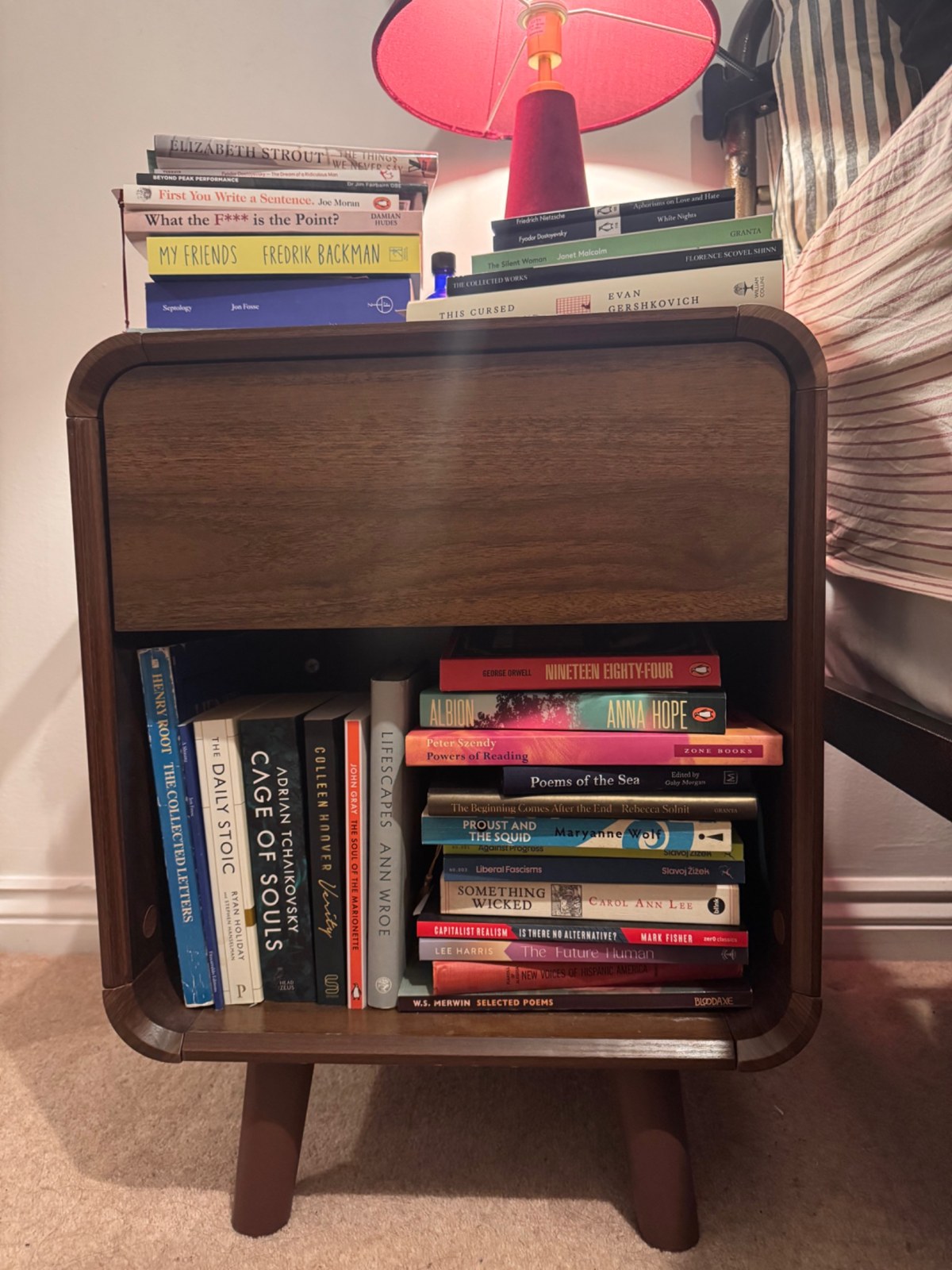
The change isn't necessarily immediate if I skip a few days. But if life gets too busy and I go for two weeks without reading, I'm still exposed to all that language through my work. Then I notice how much effort it takes to choose something I would usually say.
I have just finished rereading 1984 by George Orwell. Some of the language may feel a little dated, but I very much enjoyed the longer, meandering sentences, the insertion of a thought whose relevance was not immediately apparent, but which the author had evidently felt compelled to include.
The rich texture of this sort of layered writing can be challenging to comprehend at times, but that’s exactly why you remember it… Because it made you cognitively work for morsels of understanding, until your imagination could complete the puzzle of the author’s thoughts.
Reading human-written material may elicit all sorts of reactions from us. We may feel intrigued, taken back by a sentence or a character’s expression, we may laugh out loud, we may abruptly close the book with disgust, or get angry over a particularly unexpected ending…
All of these are natural human reactions and ways of processing the experience of what we’ve just read. We can be following an internal conversation when an apparently unrelated thought interposes itself. We do it when we speak to each other, too. That's something I enjoy finding in a book, that room for a thought to interrupt another thought.
I get a different sensation from reading a physical book. The tactile pleasure of holding it, of turning the pages, my finger occasionally following a line. It feels like a more connected act, the words becoming a scene that plays out before my mind's eye.
All of this to say that I don't get the same experience from reading anything that’s obviously AI-written, no matter how many stylistically perfect words, sentences, paragraphs a page is padded out with. You can feel the absence of the human.
Reading material produced before people started writing books with generative AI, or books where I have good reason to trust the human authorship, isn't the only way to counter that exposure. But it is something I can consciously and regularly do. I can notice when I haven't been doing it, and get back to my book-reading habit again.
I'm noticing less and less colour in the way people write and even talk sometimes, and I worry about where that leads. We may still have all those complex, beautiful words, but what happens if we don't think to use them any more?
That's what I mean by devolution. I worry that as our language becomes flatter, we lose some of the colour in how we communicate and connect with each other, too. I notice it in myself, and it takes a real effort to choose something I would usually say. Reading helps me with that.
When I read regularly, I remember words more easily and find different ways of putting them together. I enjoy the meandering sentences, too, and the apparently unrelated thought an author felt compelled to include. It would be such a shame to lose that colour.
I can't choose everything I'm exposed to through my work, but I can pick up a book and spend some time with language I wouldn't otherwise encounter. If I go a couple of weeks without reading, I feel the difference when I sit down to write. That's reason enough for me to pick the book up again.
So, what's on your reading list right now? How are you fighting back against the algorithmic accent?
Sources
[1] Dergaa and colleagues, “Passive exposure to AI-generated text may reshape human academic writing through established cognitive mechanisms”, Discover Psychology, 27 October 2026. Hypothesis-generating perspective.
https://doi.org/10.1007/s44202-026-00954-7
[2] “Model Misalignment and Language Change: Traces of AI-Associated Language in Unscripted Spoken English”, Proceedings of AIES 2025. Observational evidence; causal attribution remains unresolved.
https://ojs.aaai.org/index.php/AIES/article/download/36540/38678/40615